
“We shall not cease from exploration, and the end of all our exploring widdershinning will be to arrive where we started and know the place for the first time.”
I came across this TS Eliot quote before I left for Europe in 2008. It seemed cool then, when I was a cool 22, but now feels even more relatable for me. This world travel has definitely given me some new and more developed perspective on American culture and the specific places I’ve called home. Even so, being back, the overwhelming feeling is that not much has changed. I’ve been busy enough since returning that I haven’t had too much time to dwell on everything that has happened. It also feels like it occurred far longer ago, but I suppose some of it has, when I acknowledge that it began nearly half a year ago. Writing about it now has helped keep the light of the memories bright. I will try to recall it all as I say my final piece about this wide world and my experience widdershinning it. While some of these thoughts I’m sharing have been synthesized over the course of many introspective moments during the trip (either jotted down or bounced around my head until I typed them up), or elicited from questions I’ve been asked, they’re not being presented with too much thought, so my apologies if this collection of thoughts and opinions and memories reads as disjointed and run on (like this sentence) – but perhaps that reflective of my trying to encapsulate everything I experienced and haven’t yet written in one spot. This is a lot of text to read, though if you made it this far, you can probably power through these final thoughts of mine. Or not, because they very well might not be that interesting. Even if you don’t finish this post, if you haven’t seen The Best Of recently, czech it out! It’s been updated with the best of the best. Now, onto some random thoughts as the result of a 4+ month 20 country world trip.
Also a heads up before you scroll to see what interests you – no photos! Again, see the Best Of for more pics.
Communication is a fascinating thing. Going just beyond language, we do many things the same across continents and cultures, and of course some differently. Despite often being illiterate in most countries I was usually able to guess the basics of what people were thinking or trying to convey based on facial expressions and body language. Nodding, thumbs up, holding up numbers typically worked. But not everyone nods like we do. Indians bobble their heads, with no discernable pattern. I once asked a waiter if I pay at my seat or at the register, and he just bobbled his head at me. Not shaking left and right or up and down, but like a bobblehead on a dashboard. I generally took it to mean an acknowledgement that they’re listening, but it was especially unclear in this instance. Meanwhile, the Japanese very effectively communicated “no” by holding up their arms in an X across their chest/face. They did this when I attempted to get into some bars (and they didn’t want my American self in there) or when I asked for meals to be included in my accommodations at the monastery. To me it felt like a ruder symbol than was probably intended. But no symbol was more universal than pointing. No one was ever confused by the point.
One thing that struck me is how English was spoken just about everywhere. Throughout Europe it was a near guarantee that everyone could speak English. I often prefaced my interactions with the innocent question of whether people spoke English. Even when they answered ‘a little,’ ‘kind of,’ or ‘not really,’ we were able to communicate well enough. In Asia I found some situations where I couldn’t communicate, and either another party jumped in to help or motioning got my point across. Speaking English also seemed to be a prerequisite to being a backpacker. I was amazed how, regardless of country of origin, it was one commonality we all shared in hostels. In Hanoi I met a Polish and Colombian girl who had adopted each other as travel buddies, being able to bond through their non-native English. Even met a French and Spaniard conversing in English, despite each knowing one another’s language. I lumped being a native English speaker in the privilege bin I found myself continually aware of and thankful for as I widdershinned my way.
Italians had the most flowery language and hands. I spoke with some about this (in India was the most memorable of these conversations), and they acknowledged that they’re a handsy bunch. As the conversation ensued I began to point out the over-the-top actions they do with their hands, which surprised them /made them laugh when they became more aware of just how much they motion. They translated some of these and explained how (not surprisingly) the bigger the motion or double handed ones were to express things more emphatically, which they did quite often. I also told them how I love their ‘shoo’. They swat things one handed or sometimes two to dismiss it or indicate their distaste in it. This accompanied a saying of theirs which Max and I took to, “mi fa cagare,” which is a negative reaction and translates roughly to ‘makes me want to shit’ or ‘makes me shit myself.’
I didn’t have any epiphanies while out in the world, but I did think through a lot of what I experienced. My most poignant thought is: humans are extremely adaptable. Along with that, creature comforts, more than anything, stem from the familiar. Could I live easily and comfortably in Europe, where the quality of life is similar to America? Yes. But I’d miss a number of things, including all of my default habits that are attuned to our mannerisms and customs and way of life. Meanwhile, the idea of expatriating to Asia would be less appealing, especially in some of these developing nations, but more so commensurate with how different the customs and how foreign the language is. Things I struggled with in India or Kathmandu were invisible to many of the locals, who took for granted what I felt I needed to persevere through. With that said, I’m sure I would’ve loved teaching English abroad as a younger man, but at present I think that opportunity is behind me.
The more places I visited, the more I realized just how adaptable we are as a species. Yes, people move. Yes, people prefer living in some places to others. I met plenty of folks who expatriated from one place to another. But many people living in places and conditions I would’ve happily avoided didn’t question their environment. All over the world people exist and persist in a wide range of conditions, going about their routines and daily lives. Those in poverty seemed able to find happiness, and many people who I learned worked seven days a week were able to be extremely positive and provide excellent service (better than in the US) without working for tips. I wouldn’t call these people ignorant, but the closest analogy I can identify is ignorance is bliss. In some cases it was naïveté, but it was probably an acceptance more than anything. Particularly in southeast Asia, these people accepted their station, their lack of geographic and social mobility, and found what joy they could in their situation. The times I had personal conversations with them when their guard was down, they expressed how they couldn’t believe it when westerners complained about their lives, as the mere fact that we were tourists there was representative of how good we have it.
The world is huge. There are so many people on this planet. But still, every person is a person, and through that we are all connected. I recognized that for all our differences, we have infinitely more in common with other inhabitants of the globe than anything else. This shouldn’t come as a shock, after all we have 65% of the same DNA as lettuce (or something like that? Sources and statistics of these kind of numbers are highly variable). I’m not talking about the physical differences, though. Everywhere I visited was at least somewhat modern, where there was access to technology and information. Whether backpackers or locals, people were almost always kind, unless the occasional language barrier made them not want to interact. Like I said, I don’t have much to say that’s profound.
I obviously thought a lot about being a tourist. I didn’t love this in some of the poorer places, specifically India, Nepal, Vietnam, and the Philippines. I generally didn’t feel unsafe in the poorest areas (though I did at times watch my back and keep my valuables extra secure), but I felt like the locals were being exploited, and I felt my own personal guilt. I figured I should either find ways to help these people through my being a tourist there, or go elsewhere. One hostel offered a “slum tour” as one of their activities which my new friends and I agreed sounded awful.
When I tried to avoid seeing things that would make me feel sad for the locals and bad about my behavior, I was thrusted further from the authentic local experiences and more into the touristy world. This was inevitable. I, being a tourist, already affected the authentic nature of any place I went because I was an invasive species. The very touristy areas and sights typically fell into one of two categories for me: they were fantastic and thus the tourists were inevitable (i.e. Cologne Cathedral, all of Rome, Halong Bay, etc.), or they weren’t special/unique enough to deal with the crowds and warrant the attention (i.e. shrines of Kyoto in the rain). But I may have also just been in a bad or impatient mood during the days and times that the tourists got to me. The extensive length of my trip also gave me the luxury to dismiss some “must-see” sites, because I had racked up a litany of these along the way. Traveling alone also made dismissing some things easier.
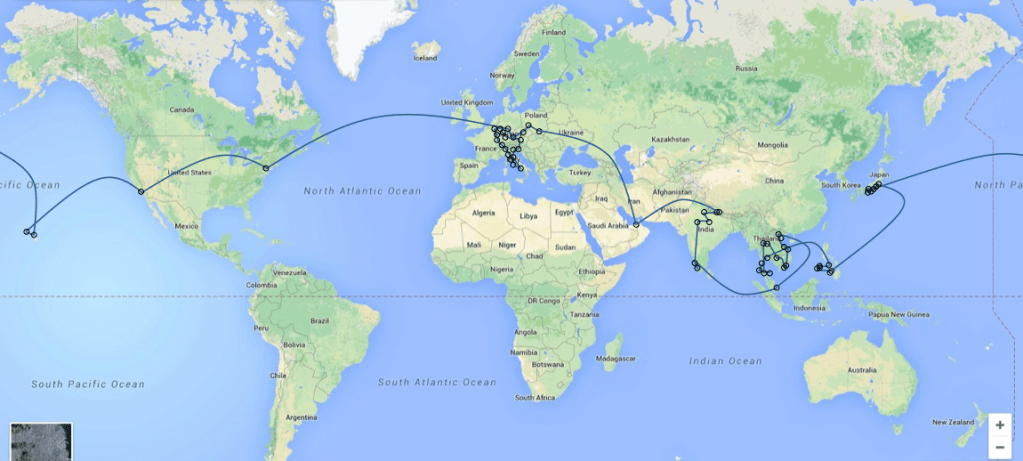
I really enjoyed the solo aspect of most of the trip. Ignoring the “new friends” I made along the day, the pattern of alone or accompanied was: 23 days alone to start in Europe, 3 days with company in Italy, 30 days alone for the end of Europe and start of Asia (would’ve been halved if Aungeer didn’t bail on me in India), 3 days semi-solo interspersed with company in the evenings in Singapore, 13 days alone in Vietnam (if omitting evenings with Aaron in Singapore, this would’ve been a 46 days solo), 21 with – 2 days with company in Cambodia followed by 19 in Thailand, 36 days alone spread between Japan, the Philippines, and Hawaii (I did coincidentally have an acquaintance traveling in Tokyo who I made impromptu plans to see twice) and then with company in the last 3 day stop of LA. Throughout the solo (and sometimes accompanied) times I made new friends with whom I spent anywhere from a few hours to a few days with. The criteria by which I identified these 89 ‘new friends’ was loose, but I basically decided had to be more intentional than just meeting and doing an activity with – either a more personal connection, plans to do an activity, or multiple things in tow. These new friendships, although often fleeting, were both a benefit of being solo and protection against the negative side of loneliness.
Earlier in my trip, I found blogging as a substitute for traveling alone. When I had a thought that I had no one to say it to (including quips, jokes, realizations, what have you), I jotted whatever my thought was down in my phone and inputted it into the blog later. I kept this up pretty religiously until southern Italy, when I had my first visitors. Then it was more intermittent, until I basically stopped entirely in Thailand. I started back up in Japan (this is likely reflected in the amount of thought that I shared in my posts).
Europe was lonelier, probably for a number of reasons. It was still early in the trip and I probably wasn’t as social as I became later on. I did ok breaking the ice, but think I was more inhibited. I also moved extremely fast through Europe, staying in many places only one night. This made it hard to meet and connect with people. I also didn’t exclusively stay in hostels, and I was going to have a far tougher time meeting anyone in the airbnbs or hotels I stayed in. I also found that many of the other European backpackers were younger (early 20s was very common), but what made it even harder to connect was that they were often traveling in groups. Asia had a wider range of people that I came across, more in their late 20s or 30s or older (a few retirees), and far more often solo. As a result, when time went on, I met more backpackers and made more friends.
Sometimes when alone I found myself just going places for the photo, and moving on. I didn’t intend to, but I’d get somewhere beautiful or historic, take the perfect shot, and then not know what to do with myself. If it was a peaceful natural place, I still found myself not lingering too long if I had no one to talk to. I also tried to strike the right balance of being present and enjoying the moment vs. documenting it. Obviously it’s easier to remember down the road if I have a photo of it, but there were times where I was fixated on the perfect lighting of a sunset, when I could’ve otherwise sat back and enjoyed watching the sun set. Again, I think this was often a product of solitude, and maybe some obsessive compulsion on my part.
At some point in the trip (I don’t remember when) I decided that a perfect photo masks the experience. By perfect photo I mean a one with no crowds, no electrical wires, no trash, whatever. Good luck taking a picture of the Pantheon without people in it. But you also have no chance of experiencing the Pantheon without hundreds or thousands of other people – that is just part of the experience. I wasn’t photographing the world as I saw it to get something put on the cover of National Geographic (do they still produce print materials?). Therefore it was more representative of my experience if my shot of some countryside had the railing and telephone poles that I saw when staring out, or the crowded beach has people in it.
Back to traveling alone for a second. While the aforementioned loneliness did occur at moments, I completely feel it was the right way to do this trip. It was predominantly freeing and glorious and accommodated nearly every whim and need I could identify. And like I said, meeting new people from around the world was a great feature that was minimized when I had company. For a while I liked retelling the same story, and I was able to condense it down to the most salient and interesting points. I did at times get tired of recounting it (the ‘story’ being my trip, more or less, as one’s travel plans was the most frequent topic). I eventually boiled it down into something along the lines of: I did a one month road trip in central Europe and three months in Asia (though this began as two months in Asia). I let people pick and choose where they’d pry for specifics. I also sometimes left places out when running through the list of countries, most often Dubai and Singapore because I was in each so briefly and found people asked fewer questions about those two. Sharing the itinerary, I was able to provide advice to someone going in the opposite direction, while I benefitted from being handed other peoples’ knowledge and recommendations of places I was about to go.
I think the single best part of being alone was changing my mind. If I wanted to speed up or slow down at a moment’s notice, I could. If I wanted to stop for the day, I wasn’t ruining anyone else’s time. If I needed food, or a detour for a bathroom break, or to relax, I just did it, almost instinctually. If I wanted to walk 40,000 steps in a day, I didn’t have to worry about how anyone else was holding up (I surpassed 40k only twice). I have always valued some alone time and have prided myself on my self-reliance with many things, so I suppose I was in some ways already well-suited for this. I’m also now quite open to other solo trips if and when the opportunities present themselves (i.e. if I wake up one day and decide to go somewhere… once I have discretionary income again). Given how frequently I had to make a plan, one of my favorite parts of traveling with people, whether new friends or old, was letting them make the plan for a morning or day or two. I was of course also happy to have this company, and would readily go with the flow, though nothing was more freeing and suited to my whim and needs and interests than being alone out there.
Saying goodbye to ‘new friends’ was always interesting. Often there was an exchange of Instagram handles (if that hadn’t already happened). I didn’t literally wish anyone to have a nice life, but that was basically the message. The most common genuine goodbye was, “let me know if you ever come to my city/country and we’ll meet up!” But there were missed goodbyes just as often as they were sincere. Usually when one person was sleeping and the other was leaving early, or they just weren’t present at the exact time I was leaving and waiting or looking for someone to say goodbye when I’d never see again was just a waste of time. The amazing experiences or sometimes stress of whatever our travel was more quickly bonded us while our guard was down, so it was a strange sensation to know that the connection would only last a day or three.
Another thing that struck me about everyone from everywhere else was smoking. I didn’t expect seemingly every person, backpacker or local (wherever I found myself), smoking. Granted I was amongst more carefree young people in and out of hostels and there was often drinking, when and where people are more likely to smoke, I was definitely in a small minority for being smoke free. I also expected there to be more vaping, which there was not. I saw far less vaping than I do in the US, in addition to drastically more cigarettes. It seemed that Americans and Canadians were the most likely not to smoke, and even that was unlikely.
I met far fewer Americans along the way than folk from other countries. Lots of Australians and disproportionately a whole lot of New Zealanders. A good number of Brits, many Germans, some French, a few Italians, some Spaniards, a decent showing of Scandanavians, the occassional Russian, a few rare Latin Americans (Colombian, Brazilian, and Mexican, were most frequent among these), and most accents that sounded like home belonged to Canadians. Obviously there were others, but these seemed to represent the biggest block. The few number of Americans was a conversation topic more than once, and I worked out some theories on why that was. First, it is geographically further from most other places (though for Australians this is even moreso). As a result it’s reasonable that Americans are more likely to travel in the Americas than these sometimes far away places. Second, we don’t get time off like other people do. Two weeks is a long vacation by American standards, while I met people on a 4-week work holiday from elsewhere. Third, America is geographically and culturally big and diverse. If you want to see mountains, beaches, lakes, rivers, desert, forests, plains, etc., you’ve got it in the homeland. There is so much to see within the US that you don’t need to spend the time and money to go abroad. Fourth, xenophobia. This goes both ways, as American have get bad rap abroad (no more warranted that other people… for the most part), but stereotypically, we aren’t as embracing of others. Obviously this is a very broad and inaccurate generalization, but our current president is in some ways a representation of this. And because of all of this, I assume that we developed a culture of more domestic travel than heading abroad.
Like I said, I didn’t have any revelations or moments of clarity. There was no divine inspiration. I didn’t formally adopt any new mindsets or mantras, but I did pick up some new behavior here and there.
Number one in my widdershinning mindset, which will hopefully carry over to this American life is to be open. Maybe that was an informally adopted mantra. This extended to everything. In order to maximize my fulfillment I needed to be open to new experiences, activities, foods, environments, and most of all people. I couldn’t let the infrequent negative moments or interactions allow me to close myself off (expect strategically for safety). I couldn’t let an inability to communicate or some level of discomfort deny me what I was in these places to see and do. I, at times, needed to overcome my instinct to internalize things and turn on the extrovert. I needed to have my guard down and seize opportunities to connect with nouns (people, places, and things). I needed to be open enough to change my itinerary or to-do list on a whim. I think I was moderately successful at this, although my pre-planning didn’t allow my itinerary to be as open as I might have otherwise enjoyed. In the Philippines (where I was somewhat more open but still bought flights in advance to island hop and depart to Japan), a couple of American women I befriended were dead set on their catchphrase, “Be Bold 2020.” I found openness more critical than boldness, but both were valuable while backpacking.
In the interest of sharing a phrase, I have always appreciated Sarah Connor’s saying from the Terminator, “no fate but what we make” (I don’t know to credit James Cameron or Linda Hamilton or someone else with this). The opposite of the popular ‘everything happens for a reason,’ I had already leaned to the concept that our future is in our own hands. I actively chose to hit the eject button from my job and life in Boston and do this trip. I made this fate, and as I went on my way, it was the decisions I made that charted my course. I did find it tiring, each day needing to make a seemingly unending slew of decisions. After a while I did just enough research to feel informed, and then just committed to something to do. FOMO is a waste of time and mental energy, I realized. Between what to see and what time to start and where to eat and how to structure it and then audibling and doing something else, each decision became less important for me, what was important was to just commit to some plan. If I missed something special, it wasn’t the end of the world. If I had a low key day where I didn’t sight-see, I’d still have plenty more to make up for it. People in a world of perpetual weekends need weekends too, you know.
Now for a more literal and logistical look at how well I did what I set out to do, and what I needed to do or change along the way. These next couple of paragraphs may not be interesting for you unless you yourself are planning to go widdershins.
I had a cell phone plan with limited data, so I kept my phone in airplane mode and switched out of it only when necessary. These days wifi is available all over the place, you sometimes only need to ask. I relied very heavily on Google Maps. I downloaded offline maps for each place I went, which provides driving directions, and used my GPS in airplane mode to get around. I almost exclusively found myself in places where I was comfortable holding my phone out in the open, while I avoided this once or twice. The other app that was incredibly useful was hostel world, obviously this is specific to a budget backpacking approach. I was surprised by how many backpackers chose to communicate through Instagram direct messages, but after thinking about it, it makes sense. It’s a platform that many millennials use frequently, is associated with their social media identity, and even if they change sim cards from one country to the next, their Instagram in constant and conveniently located in an app (unlike WhatsApp for example).
I think I packed decently. Having the multiple climates was challenging, and though it mostly went from fall in Europe to (what I would identify as) summer weather in Asia, I still seemed to need it all everywhere. I had lots of expensive warm socks – in retrospect cheap warm socks would’ve been better because i could’ve just tossed them. But the heaviest pair worked as sunglasses cases, so ingenuity was a win-win. There were times I thought I had too few heavy socks and others when I thought I had too few light, so I’ll say I had the right amount of each.
The thing I bought the most of was shirts. I’m probably a bit of a shirt clotheshorse in general, so I found myself having too few shirts along the way. Cheap ones were disposable, so that worked too. Otherwise have remained souvenirs. I deliberately didn’t bring any logos or clothes with much wording to out myself, but everyone had English on their clothes in Europe and Asia alike. I didn’t bring a baseball cap, thus I bought a Yankees hat (after they were eliminated from the playoffs because I didn’t want to jinx it. Maybe my delay had the opposite effect).
I didn’t bring an umbrella and sometimes through I should’ve but I never bought one and did just fine. I did buy soap, toothpaste, deodorant, and immodium AD along the way. I didn’t need all the tylenol or lotion I brought, I had prescription antibiotics which I never touched (though the Indian pharmacy I visited gave me some which I took) and in general felt like I never used half of the stuff in my toiletry kit. I had a larger and smaller toiletry kit (big buddy and little buddy as I nicknamed them), which was nice to be able to pull out only the small one for the everyday items. Similarly, the easiest to access pockets of both my backpacks had nicknames: quick release and big quick release. Some people felt a rolling suitcase is preferable but I never regretted my backpacks for a moment. These wound up weighing a combined 50+ pounds or so (fluctuated somewhat) – my larger checked bag clocked usually in at 11-13 KG, and my smaller bag wasn’t too far behind most of the time.
I didn’t use my GoPro as much as I should’ve, in part because getting the large files onto my computer and into my edited videos was such a nuisance. I also brought two metal sporks, which I flew with multiple times until they got confiscated when leaving the Kathmandu airport (where ironically the airport and security seemed the most archaic). I brought a wintercoat and light rain jacket, both of which I lost (rain jacket at Oktoberfest and coat in Poland). I replaced each of these along the way, with far cheaper off brand North Face coats in Kathmandu and Hanoi. I also brought 3 water bottle-pouches at 1, 2, and 3, liters (the 2 is a camelbak with hose). I never used the 3 liter and the 1 liter disappeared, I’m pretty sure I left it on a subway in Singapore, where there’s a fine for littering.
Prior to leaving I opened a checking account with no foreign transaction fees that actually also reimbursed me for some ATM fees – thanks Charles Schwab! I tried to avoid converting currencies because this usually meant losing about 10% of the value. Thus, if I was still flush with cash when going from one place to the next, I tried to ‘spend down,’ sometimes on somewhat frivolous expenses when it came close to time to go. I got stuck with about $10 worth of Cambodian cash which was not able to be exchanged anywhere – no one wanted it, and I tried over the course of a month or so through Thailand and the Philippines. Eventually I just put it in an amnesty international donation box. Change is not accepted at exchange places, so I came home with 4 Japanese Yen (4 cents), 30 Singapore cents (20 cents), 10 Filipina Pesos (20 cents), 16.5 Polish Zloty ($4.17), and $1.33 American (not sure if I left with this or acquired it along the way). It was never my intent to collect coins from abroad, but now I have a small cache.
My compression packing cubes came in extremely handy, despite not being the perfect fit for what was really a hiking backpack. I also got an international outlet adapter that worked everywhere and had two USB ports, which was glorious. This was used to charge both my phone and a charging case, which was good to bring around so I could swap cases and recharge my phone without any cords. These were probably the product MVPs of my trip.
Now that I’ve been all these places, I’ve wondered what’s next. I might have at some point mentioned Nepal is the place I went that I most want to return to next. Of the places I didn’t go, there’s still Australia, New Zealand, South America, Africa, Laos, Indonesia, more of Cambodia, China, Greece, Croatia, Hungary, Romania, and Portugal, and all of Scandinavia, to name a few. And northern and southern Japan, Italian islands, more of Austria, more hiking in Switzerland, Berlin, among other parts of countries I visited but not in totality. Other than moving too quick, I think the itinerary was a good one. It better have been after I poured over it for weeks and locked myself in prior to my departure.
One thought I had jotted down at some random moment in Asia was “YOLO – but reincarnation?” And by this I meant, you only live once. Getting out there and doing what you’ve fantasized about and putting yourself in a position to feel as free as possible is a wonderful thing, and if you can, you should get out there and find your bliss. I tried to remind myself whenever I could that I don’t expect to have this four month opportunity again and might never return to these places, so I had to say yes as often as possible and appreciate it all and soak it all in. Life is short, and you only live once, so live it big and bold and open. But – what about reincarnation? I assumed that Hindu and Buddhist cultures don’t have YOLO in their lexicon. When amongst these religions, should I have changed my outlook, from trying to do it all in this life, to trying to reach nirvana? Finding the peace, spirituality, and passive appreciation for the world that they prioritize was important too. While not a belief system I ascribed to, on this trip, what I’ll call eastern mindfulness served as my yang while my desire to be fast moving, active, and hedonistic was my yin.
At some points this trip and especially staying in the hostels felt like I was clinging to my youth. Or trying to make good on my failed promise to myself to backpack Southeast Asia as a youngin’. This was moreso true at the self described “party hostels,” and here and there on nights where I found myself with a drink in hand at the wee hours of the morning. In the end I was happy with my balance of wild nights, quiet nights, and those in moderation. The hostel scenes varied and my behavior was only sometimes influenced by peer pressure (I use the term peer loosely in some instances). I also have no regrets about the hostels. I wouldn’t have been able to afford it if I stayed in nicer accommodations. While hostel dorm rooms were by no means pleasant or luxurious, they did a few positive things: they introduced me to more people, they kept it cheap, and they made sure I didn’t spend too much time in bed or lingering in my room. Being out and about was what this was all about! There is a part of me that wishes I could’ve done this trip when I was younger, while another large part of me has no regrets and is just glad and grateful that I did it at all. Gratitude is among the more poignant thoughts and feelings I have at this point. I’m thankful to myself that I chose to do this, thankful that I was in a position to be able to do it, and thankful to the world for being widdershinnable. And with that, I’m no longer Widdershinning Weiss.
Now, something to leave you by. Remember when I said this blog was more for me than it was for you? (Did I say that?) Well, I have a sneaking suspicion that blog playlist is one of the ways that this is something I did and will enjoy, most (if not all) of you paid little to no mind to. But, here it is; the blog playlist:
- Ain’t Seen Nothing Yet (Packing and Anticipation) Bachman Turner Overdrive
- Houses in Motion (Departure) Talking Heads
- 99 Luft Balloons (Oktoberfest in Munich) Nena
- Drive My Car (German Countryside) Beatles
- Avenu Malkenu (Yom Kippur in Germany) Phish
- Self Immolation (Western Europe Whirlwind) King Gizzard and the Lizard Wizard
- Roundabout (Interlaken) Yes
- Mountains Beyond Mountains (Swiss Alps) Arcade Fire
- Jesus is Waiting (Northern Italy) Al Green
- When I Paint My Masterpiece (Rome and Pompeii) The Band
- You Enjoy Myself (Florence) Phish
- Misty Mountain Hop (Austrian Alps) Led Zeppelin
- Direwolf (Prague) Grateful Dead
- Sea of Madness (Poland) Crosby Stills Nash and Young
- One Big Holiday (Dubai) My Morning Jacket
- Phenomenal Cat (Kathmandu) The Kinks
- Mr. Blue Sky (Himalayan Paragliding) Electric Light Orchestra
- That Smell (Delhi) Lynard Skynard
- Tomorrow Never Knows (Kerala India) The Beatles
- Dance Yrslf Clean (Singapore) LCD Soundsystem
- Tropicalia (Northern Vietnam) Beck
- Shadow of a Man (Southern Vietnam) Oysterhead
- What Deaner Was Talking About (Cambodian Temples) Ween
- Feather Pluckn (Elephants in Chiang Mai) Presidents of the United States of America
- Once in a Lifetime (Thai Scuba Diving) Talking Heads
- Welcome to the Jungle (Khao Sok and Bangkok) Guns N Roses
- Can’t Find My Way Home (Bonus month – Philippines) Blind Faith
- Castles Made of Sand (Philippines) Jimi Hendrix
- Jump (Canyoneering) Van Halen
- Godzilla (Tokyo) moe.
- Monkey Man (Japan and Asia) The Rolling Stones
- Back in Time (Japan to Hawaii) Huey Lewis and the News
- Over the Rainbow (Hawaii) Israel Kamakawiwo’ole
- Heart of Gold (Los Angeles) Neil Young
- Homeward Bound (California to New York) Simon and Garfunkel
- The End (The End) The Beatles
And in the end, the love you take, is equal to, the love, you make.
(ahhhhhhh-ahhhhhhh-ahhhhhhh (fadeout))

 Widdershinning Weiss
I made the cut!
LikeLike
Hi, and welcome home (I think I already wrote that…but maybe now you are more rested and can hear it again).
Another thing that occurred to me while reading your finale (as well as one of your earlier blogs where you discussed the privileges of being you) is that you were able to spend time traveling solo because you are a capable and able male. While it sounds like you met many women along the way, my guess is that they were traveling with someone else or they were just on a very short trip. When I’ve traveled by myself, even to something more social like a conference, I’m keenly aware of my personal safety and how and where I am at all times.
I used to go camping and backpacking a lot (with others, never alone) in the Rockies and Canada but only stayed in a hostel once…and it was terrifying. It had a multiple-person bunkroom and there were two women arguing loudly and another who had horrid body odor. I felt trapped and obligated and couldn’t wait to get away by myself. Glad you didn’t find that to be true…but I think some of that is because, as a male, you can more easily set the agenda for yourself and stake out your own territory. And then there’s the whole safety thing…which isn’t a hostel issue so much as a lone-woman-traveler issue.
Before smartphones, women took books with them to go to a restaurant or bar for a bite to eat, in order to send a don’t-bother-me vibe out, and even then, it is quite common for someone to interrupt and hit on you.
In one hotel, I recall getting off the elevator late at night but on the wrong floor (because I had reversed by room number and floor from something like 1213 to 1312). I knew that I had to walk down a long hall way and turn a corner to get to my room and there was a guy who got off the elevator behind me and was following pretty closely the entire way. When I realized my room key didn’t work and I was on the wrong floor…and he was still standing in the hallway watching me. I had to reverse direction and go back to the elevator and he didn’t seem to want to let me pass. I spoke out loud to try and break the tension and laughed nervously and said I was on the wrong floor and he didn’t laugh and asked if he could help me find my room. It was a panicky moment and I recall that by the time I got back to the elevator (with him still sort of following me) that I was nearly running. When I got to my room and double-locked it, I recall thinking more clearly that maybe he was the one suspicious of me, like maybe I was casing the floor or really didn’t have a hotel room. But I also recall how much larger he was than me and that he could have overpowered me quite easily.
Another time, on a subway (in NYC!), I felt my purse strap on my Coach bag being ‘unclicked’ from the back and it being pulled off my shoulder just as the doors were opening. I reacted that time by screaming NO and yanking my elbow back so hard I bruised it on his jaw or shoulder (or some bone…not sure where) and my grabbing the purse part meant he just got the strap (which the Coach people replaced for a small fee). And while I felt rather righteous at having defended myself and kept by bag…I quickly felt like a quivering pile of mush at the thought that he could’ve pulled a knife or worse and what the hell was I doing trying to fight off a mugger?
Anyway, it was occurring to me that you also benefit from being “safer” than if I were to try what you did. I’m so glad you had a terrific trek and I so hope to get to hear about your next chapter, once you turn the page and move to a new one.
Happy Friday,
Anita
LikeLike